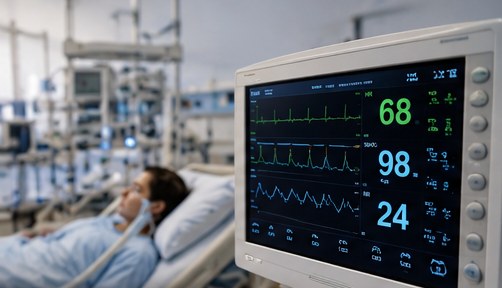

A body loses its rhythm before it loses its footing.
Every healthy system holds itself together — the beats stay in step, the intervals stay tight. We call that coherence. When a heart starts to fail, that coherence frays first: the rhythm gets subtly less self-consistent while the waveform still looks normal to a clinician and to the monitor's thresholds. Snapmatics measures the fraying itself, not the symptom that follows it.
Because it reads the structure of the signal rather than a fixed threshold, it works both directions. The same instrument that catches a rhythm breaking down also confirms one settling back to stable — a patient responding to treatment, a transplant taking, a recovery holding. Good news or bad, it sees the turn early.
Run against an open clinical record, here's what came back.
One framework. The bedside instrument it becomes.
Living Systems isn't a separate product — it's Snapmatics, pointed at the body. The same four layers that run every vertical take a specific form here.
Reads the rhythm's coherence
Takes the raw beat-to-beat signal and computes how well the heart is holding its own pattern — the core measurement everything else hangs on.
Decides when a turn is real
Governs the call so a flag means something — holding the alert until the signal clears the bar, which is how the false-alarm count stays at zero.
Sits at the bedside or on the wrist
The product a clinician actually touches — a monitor channel or wearable that surfaces the early read in plain terms, in real time.
Explains the turn in words
Where it's licensed, EVE puts the read into language — what changed, when, and how sure — so the call is legible to the person who has to act on it.
Bring us your hardest signal. We'll show you its tell.
Device makers, health systems, and research groups: see the early read on your own data under NDA.